Data quality of the river network in Switzerland
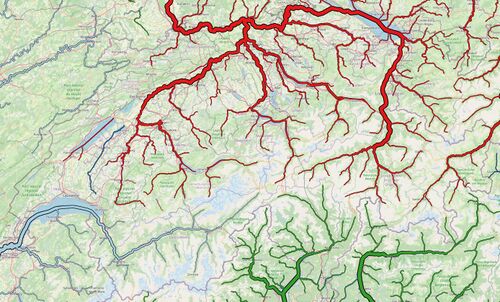
Water is essential to life and our ecosystems and water bodies can be sensitive to drought. Our landscape is criss-crossed by rivers that form river systems and water networks. This is a small research project (2025) by Prof. Stefan Keller, who is using WaterWayMap to study the water network of Switzerland and the data quality - in particular the logical consistency and trustworthiness - of OpenStreetMap.
What is WaterWayMap?
WaterWayMap by Amanda McCann is an interactive map with a data set that shows the connections between rivers and waterways based on the unique OpenStreetMap data. It offers a topological view that shows how watercourses are connected. It can display the lengths of the waterways on the one hand, and on the other hand, it can group the waterways according to their confluence. This provides a better understanding of catchment areas and watersheds. WaterWayMaps.org, like OpenStreetMap, is open source.
WaterWayMap serves several purposes:
- It helps cartographers to find and correct errors in the OpenStreetMap data.
- It provides researchers and water managers with a useful tool for analysing river systems.
- It serves as a visualisation for anyone interested in geography and hydrology.
What makes river networks special?
Almost all geospatial analysis tasks using OpenStreetMap require the data to be post-processed. Many related graph processing algorithms - such as breath first search or strahler order - require, for example, zero cycles in a directed graph. If you don't remove them all, the algorithms won't work. A tiny little mistagged path somewhere can cut off half a continent. That's a unique problem.
Now OpenStreetMap is "99.999% accurate, but not 100%" (quoting Amanda McCann in an interview (2025-01)). The visualization of the WaterWayMap helps and encourages users to continue to clean up OpenStreetMap.
What is this research about?
The five classic aspects of geodata quality according to ISO 19157 (formerly ISO 19113) are: completeness, positional accuracy, thematic accuracy, temporal quality and logical consistency. In addition, there is usability (fitness-for-use), i.e. the suitability of a data set for a specific use case.
Finally, the trustworthiness of the data comes into play, whereby a distinction must be made between the trustworthiness of the metadata (including the growing amount of metadata portals) and the trustworthiness of the actual geodata.
OpenStreetMap has already proven its fitness-for-use on a number of occasions. This is particularly true for topics such as POIs, where no official data exists or where commercial providers don't really comply with privacy standards and regulations. For topics that exist in both government data and OpenStreetMap, the timeliness of OpenStreetMap is often better than official data. This unique selling point of OpenStreetMap is sometimes forgotten because government data is typically labelled as "official data".

What is often still unclear and in need of improvement in OpenStreetMap is the quantification of completeness. OSM Completeness is another Geometa Lab research project: see figure on the right.
What is also sometimes questioned is the logical consistency, besides what OpenStreetMap has proven in providing data for navigation, especially for human powered mobility (see e.g. profiles for "Bike (City)" or "Foot (Vampire)" as proof of concept on Routing OSM.ch). As mentioned above, river networks are particularly prone to topological gaps and the data must be more than 99.999% consistent. If this is achieved, it will be another positive contribution to the trustworthiness of OpenStreetMap.
The logical consistency of river networks, and thereby the trustworthiness of OpenStreetMap, is therefore the focus of this research project.
Further reading
See also Water in OSM.